Your Business Continuity Plan: Would It Actually Work?

Most care providers will already have a Business Continuity Plan in place. But would it would genuinely help if you suddenly needed to rely on it?
Would your Business Continuity Plan work when it really mattered?
There is a big difference between having a plan available for an inspector and having a plan that genuinely helps you when something has gone badly wrong.
The last thing you need is to discover the difference when you really needed it to work.
Imagine it's 7am on a freezing January morning
- The heating has failed.
- Two staff have already phoned in sick.
- Your internet connection is down.
- A manager who normally deals with this sort of situation is unavailable.
Someone asks: “What does the Business Continuity Plan say?”
That’s a good question.
- Where is it?
- Who has access to it?
- Is it current?
- Who is responsible for what?
- Are the emergency telephone numbers still correct?
- Does it tell you what your priorities are?
- Does it cover the systems you actually use today?
- Will it help the person making decisions now?
Or would you discover that the plan hasn’t been looked at for a while and no longer reflects how the service actually works today?
A BCP should help you make decisions
A useful Business Continuity Plan isn't about predicting every possible disaster - You can't. It’s about thinking through the disruptions that could seriously affect your service and deciding, in advance, how you would respond.
For example:
- Serious staffing shortage.
- Loss of power, heating or water.
- IT or cyber failure or attack.
- Severe weather.
- Supplier failure.
- Infection outbreak.
The exact risks will vary according to the type of care service you provide but the principle is the same.
When normal operations are disrupted, what happens next?
Start with what must continue
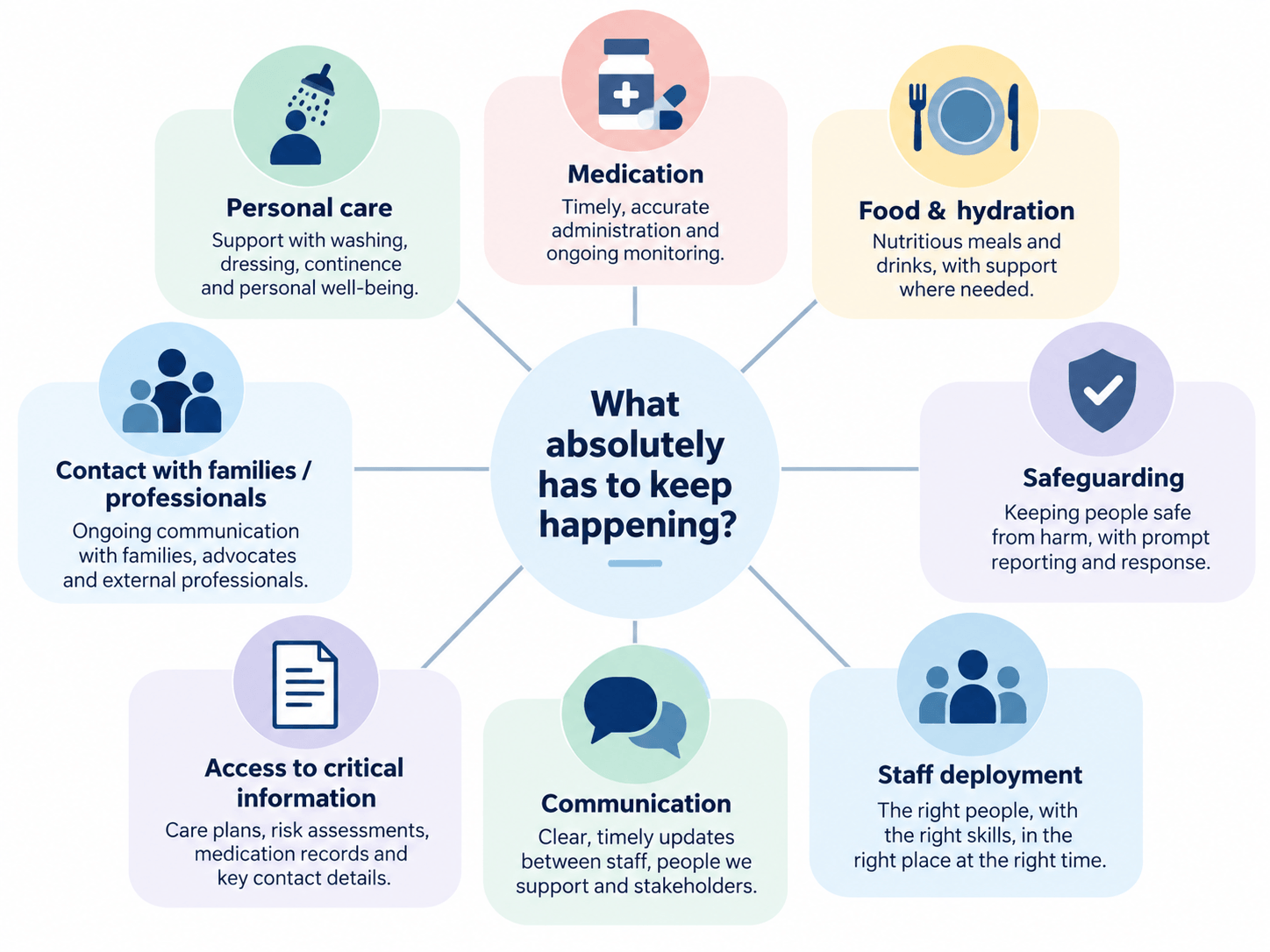
One of the most useful questions in continuity planning is:
What absolutely has to keep happening?
- Medication.
- Personal care.
- Food and hydration.
- Staff deployment.
- Access to critical information.
Once you identify the essential activities, you can start considering what might stop them and what your alternative would be.
Dependency slows the business down
When too many decisions have to travel upwards, problems sit unresolved until you or another right person is available.
And you or that ‘right person’ becomes a bottleneck. You get increasingly dragged into operational detail, into resolving issues, into answering questions, into being reactive.
And the more time you (or they) spend rescuing the day-to-day, the less time you have to lead, strengthen and develop the business itself.
On top of that, the people who should be making decisions don’t. They don’t grow as managers if they are never given the opportunity to take responsibility. That’s a leadership issue and for another time.
This unhealthy dependency leads to stagnation. The business keeps operating, but its leadership has too little capacity to move it forward.
Be specific
This is where detail really matters.
- “Management will contact the appropriate people.” – Who specifically?
- “Alternative staffing arrangements will be implemented.” - By whom?
- “Emergency suppliers will be contacted.” - Which suppliers, and does everyone know how to reach them?
When a plan is tested against a real or test situation, vague wording becomes obvious very quickly.
A strong BCP should make responsibility clear enough that somebody other than the person who wrote it can use it.
That links directly to the dependency problem I wrote about last week. If your continuity plan only works because one person already knows what the document means, the plan hasn't removed much dependency at all.
Does your plan reflect today's business?
- Businesses change.
- Managers change.
- Supplier change.
- Software changes.
- Buildings change.
- Risks change.
Which means continuity plans need to change too.
A plan prepared two or three years ago may look perfectly respectable until you discover that half the contacts have left and a critical process now works completely differently.
So reviewing and testing regularly absolutely matters.
Testing doesn't need to be complicated
You don't necessarily need to stage a full emergency exercise.
Pick a scenario. “The internet and care-management system are unavailable for six hours.”
Then talk it through.
- What needs to happen first?
- Who decides?
- How do staff access the information they need?
- How do we communicate?
- What records do we keep?
- At what point do we escalate?
- What if it continues overnight?
Even a twenty-minute discussion will often highlight assumptions, gaps or outdated information that weren’t obvious while the plan was sitting in a folder buried in a filing cabinet.
That is the value of testing and you might even make this a simple quarterly exercise, using a different scenario each time.
A plan is only useful if people know it exists
There is another simple issue that gets missed.
Who actually knows what is in your BCP?
Senior managers may have helped write it. But what about the people who might be on duty when the disruption starts?
They need to understand:
- where it is;
- how to access it;
- who takes control;
- how incidents are escalated;
- and what their own responsibilities are.
A well-written plan is only really useful if the people on duty can actually find it and use it when they need it.
This is why we created our BCP Pack
We built the Quality of Care Business Continuity Planning Pack to help providers work through continuity planning in a practical way rather than simply produce another compliance document.

The objective is not a thicker folder. It is to help you think through the risks, responsibilities, contacts and actions that would actually matter if normal operations were disrupted.
This is really why we created our BCP Pack in the first place. It grew out of business continuity training we delivered for a council, and we’ve also used it within our sister company’s care homes.
The aim was never to create another thick compliance document. It was to create something practical that helps a provider think through the risks, responsibilities, contacts and actions that would actually matter if normal operations were disrupted.
But whether you use our pack, your own framework or another system, the important thing is the same.
Test the plan
Whatever format you use, the important thing is to make sure the plan is current, understood and occasionally tested.
It is far better to discover a gap during a twenty-minute discussion than in the middle of a real disruption.
Resilience isn’t really about owning a Business Continuity Plan. It’s about knowing your organisation can continue to respond calmly and effectively when normal business is interrupted.
And business continuity is only one part of being ready for winter. Next week I’ll bring the wider resilience picture together — staffing, finance, training, systems, leadership and continuity — in a practical Winter Ready checklist.


Products

Home Care Fee Calculator