Is Your Care Business Resilient — or Just Coping?
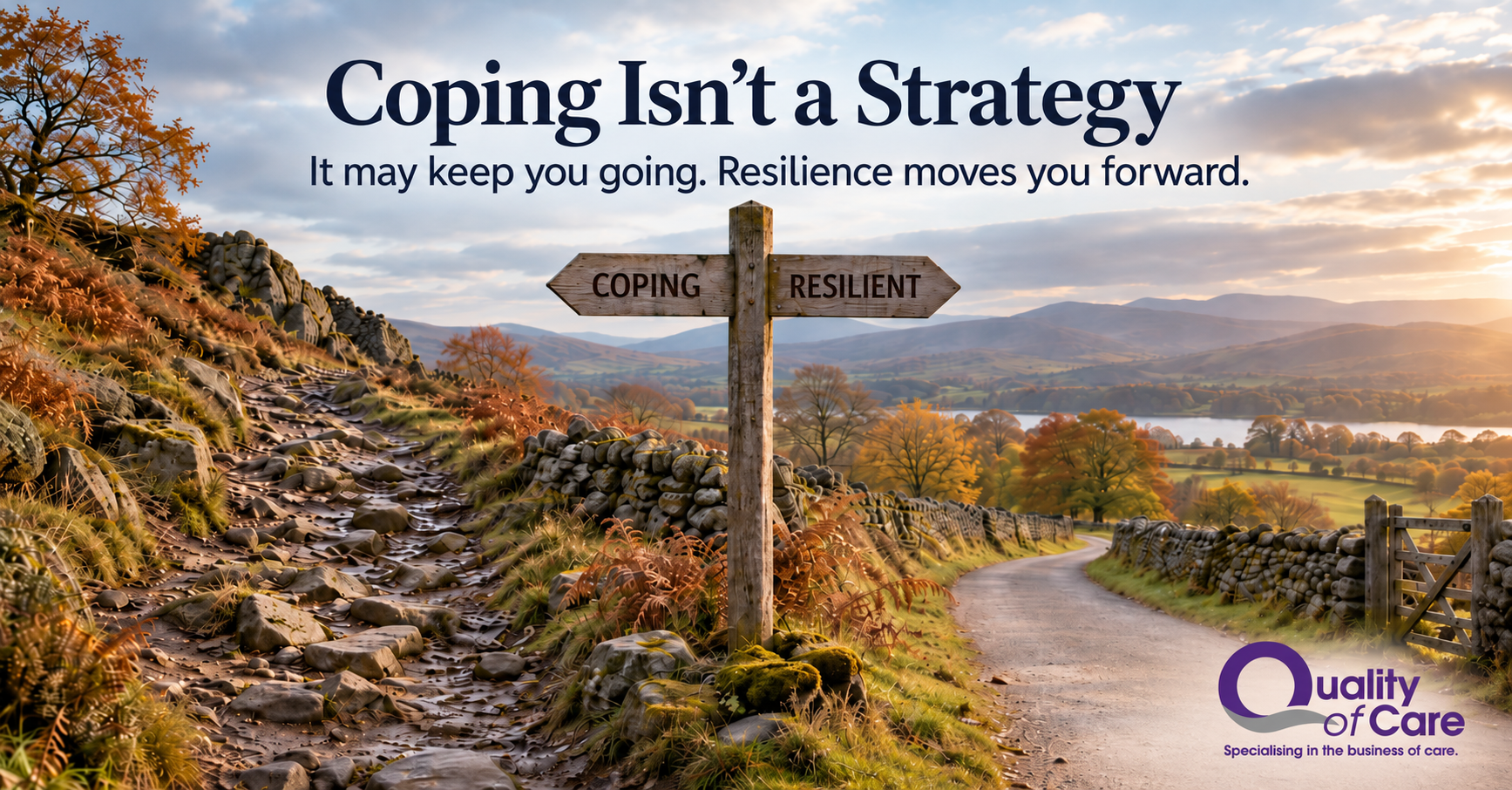
There's a big difference between a business that is resilient and a business that has simply become very good at coping. From the outside looking in, they can appear very similar.
- Shifts are covered.
- Problems are sorted.
- Customers are looked after.
- Deadlines are met.
Another week passes and everyone breathes out - job done.
But from inside the business, the difference becomes much clearer.
A resilient business isn't one where things never go wrong. It's one where problems can be dealt with without the whole organisation being thrown off course.
A coping business, by contrast, is one where each new problem disrupts the normal flow of the business and once again depends on the same people stepping in to put things right.
When things are relatively calm, a coping business can look perfectly healthy. The problems are still there, but there is enough time, goodwill and management capacity to work around them.
Pressure changes that. Pressure doesn't create the weakness — it reveals the weakness that was already there.
When staffing becomes tighter, costs rise, several problems land at once or a key person is suddenly unavailable, those workarounds start to fail. That is often when the difference between coping and resilience becomes impossible to ignore.
Resilience matters in the good times because that is when you have the best opportunity to build the strength you will need in the difficult ones.
And the difference becomes even greater over time.
A coping business uses most of its energy simply keeping today under control. Management time is swallowed up by operational problems, so there is little capacity left to think strategically, improve systems or build for the future. It may keep moving, but it struggles to move forward.
A resilient business has that capacity. Because the day-to-day operation is more controlled, its owners and managers have the time and headspace to look ahead, make deliberate decisions and continually strengthen the organisation.
That is the real long-term difference. One business is consumed by survival. The other has the capacity to strengthen, grow and improve strategically.
Resilience doesn't just protect the business when pressure arrives. It creates the capacity to move the business forward when pressure isn't there.
If keeping everything going depends on you and the same few people repeatedly stepping in, staying late, remembering what everybody else has forgotten and taking on the next problem even before the previous one has really been dealt with, you don't have a resilient business.
You may simply have a very committed core team keeping the business' head above water.
And in care, it is particularly easy for this way of working to creep up on you.
We can get very good at firefighting
Care is naturally unpredictable and being reactive is often unavoidable.
- People get ill.
- Staff call in sick.
- Needs change.
- Commissioners make demands.
- Incidents and accidents happen.
- Audits highlight issues that need addressing.
There will always be things you have to react to, but if it's you and the same people doing the reacting, it soon becomes normal.
But this is a vulnerable normal.
At some point it becomes unsustainable: mistakes creep in, problems build and eventually this ‘normal' starts damaging the business.
What would happen if your usual rescuer wasn't there?
One of the simplest ways of testing how vulnerable your business might be is to take you or those other dependable few people metaphorically out of the business.
If you or they aren't around to know how to do things, who to call, the usual workaround, the steps to resolve, what would happen?
Capable people make a business stronger. But there is a tipping point. The more the business depends on those people rather than benefiting from them, the more vulnerable it becomes.
Their knowledge, experience and judgement should strengthen the organisation, not become the organisation. A strong business gets the best from its key people without relying on them to hold everything together.
Great people are an asset; dependency on great people is a weakness.
Some warning signs
Every care business is different, but there are some patterns worth looking for.
- Are the same problems appearing month after month?
- Do managers spend most of their time firefighting?
- Is important information held by one person rather than by the organisation?
- Does the business struggle when a key person takes annual leave?
- Are you regularly surprised by costs or cash-flow pressures?
- Is keeping your staff training compliant hit and miss?
- Are decisions constantly pushed upwards because people are unsure what authority they have?
- Do you keep fixing issues rather than removing their causes?
These are signs that you are coping rather than strengthening — and that is a vulnerability no business can sustain indefinitely.
Resilience is built before the pressure arrives
Resilience isn't simply the ability to get through a crisis.
Resilience is established beforehand, so challenges are managed before they have the chance to escalate into a crisis.
Resilience comes from building a strong foundation that supports your business every day of the year – not just when something goes wrong.
With that foundation in place you will:
- Know your numbers and have enough financial strength to absorb problems without every unexpected cost becoming another emergency.
- Have clear systems broken down into processes that work without constant intervention.
- Have managers who understand their responsibilities and staff who know what to do.
- Know what information you need and where it can be found.
- Have plans that have actually been thought through rather than simply written.
September was about seeing clearly. October is about strengthening.
Throughout September I talked about taking a step back from the day-to-day and looking at the business from above.
- Where are the weaknesses?
- What are you tolerating?
- What needs attention?
And if you missed the series and the guide that went with it, it's never too late so here's the first article in that series and download the free The September Reset Guide here.
Once you can see the weak points, what are you going to do about them? This is what we are going to focus on through October.
You can't fix everything tomorrow and this is where The September Reset Guide can help you identify the recurring challenges that matter most — the things you need to fix or strengthen rather than keep coping with.
And once strengthened, the issue can be managed by the right people in your team rather than depending on the same person rescuing it every time.
That is how resilience starts to grow - not with a dramatic transformation.
With one weakness made stronger. Then another. Then another.
There comes a point where coping must stop being your strategy. The best time to recognise that is before the next crisis arrives.
The best time to do something about it is now.
Next week: Could Your Care Business Keep Running Without You?


Products

Home Care Fee Calculator