Is Your Care Business Ready for the Pressure?
Over the last few weeks, our September Reset has been about stepping back from the day-to-day running of your care business and looking at it with fresh eyes.
We started by asking where the business feels vulnerable.
We then looked at what needs strengthening.
And in the last article we narrowed that down to the three priorities that could make the biggest difference between now and the end of the financial year.
So, if you have worked through the process, you should now have a much clearer idea of where your attention needs to go.
But before we finish the September Reset exercise, I want to suggest one final test.
What happens when your business comes under pressure?
Because that is when weaknesses tend to reveal themselves.
Pressure doesn't create problems
Pressure usually exposes problems that were already there.
- A system that works perfectly well when things are quiet can suddenly fall apart when someone is absent.
- A manager who copes when everything is running normally may struggle when three problems arrive at once.
- A business that is just about financially sustainable can quickly become unsustainable when costs increase.
- And a process that depends on one experienced person can become a major vulnerability the moment that person isn't available. (I've personal experience of that one.)
The pressure isn't the problem - the underlying weakness is.
And this is exactly why the September Reset matters. It gives you an opportunity to find and strengthen those weaknesses before circumstances find them for you.
And even though we're now nearing the end of September, it's not too late to work through this series and use The September Reset Guide to help you.
Winter is an obvious stress test
As we move towards October, winter isn't far away - and it brings extra challenges.
- Staff sickness may increase.
- Travel can become more difficult.
- Bad weather can disrupt normal routines.
- Energy and other operating costs rise.
- Staffing pressures can increase.
- Managers can find themselves stretched.
- Training and other important activities can get pushed aside because something more urgent needs attention.
And, occasionally, something completely unexpected happens.
Most care providers are very good at coping and are in fact, probably too good. Year-on-year more pressure piles on you and somehow, in the main, you cope.
But the ability to keep things going can hide how much pressure the business is actually under. And then one day the pressure becomes too much and coping quickly becomes surviving which very quickly becomes too-late-to-come-back-from and you end up closing.
So rather than asking: “Will we cope?”
Rather than waiting for the pressures to build and hoping you will cope.
Ask: “Where are we most vulnerable if the pressure increases?”
And then do something about it so you handle the pressure when it comes.
Look at your business under pressure
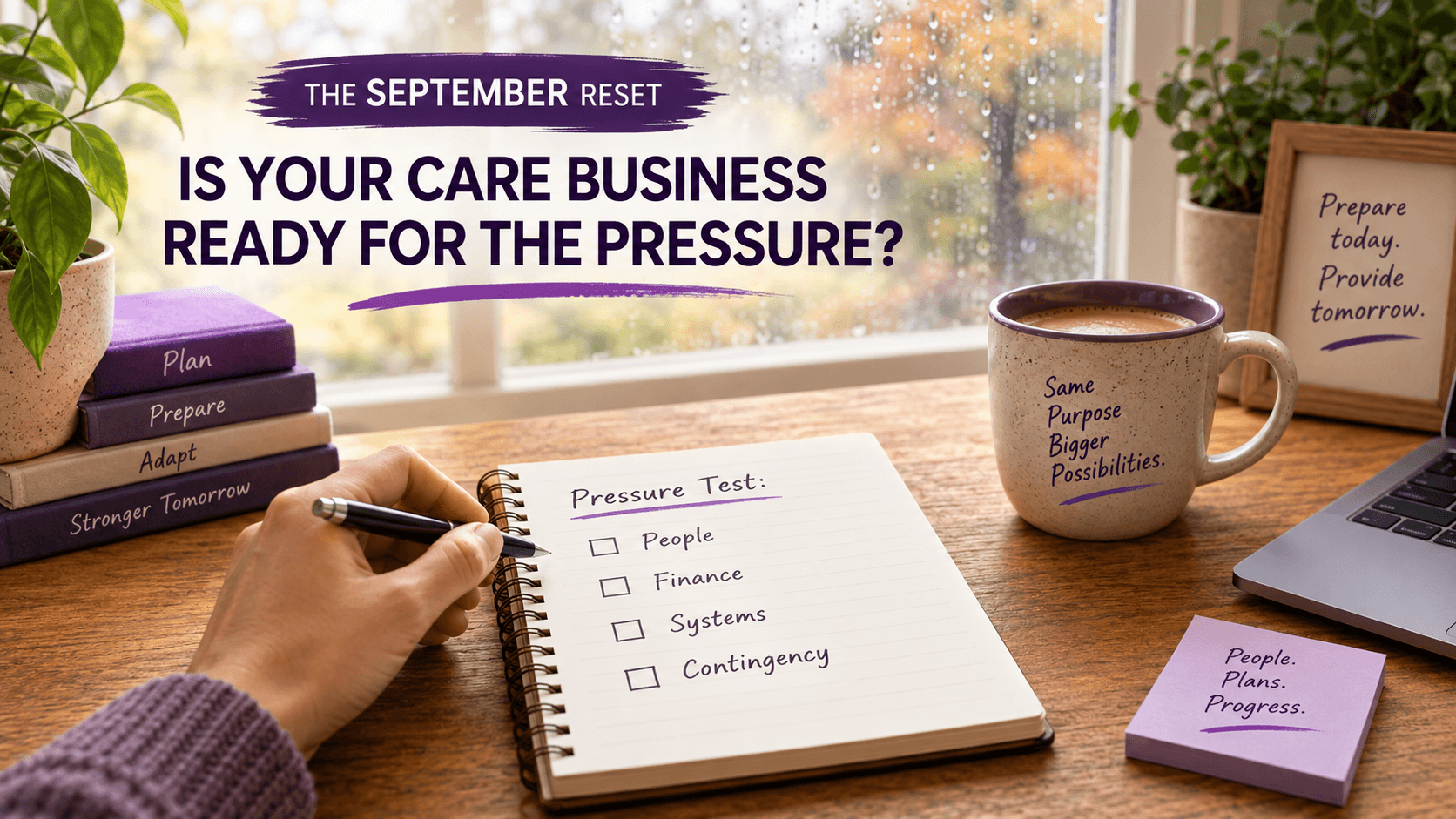
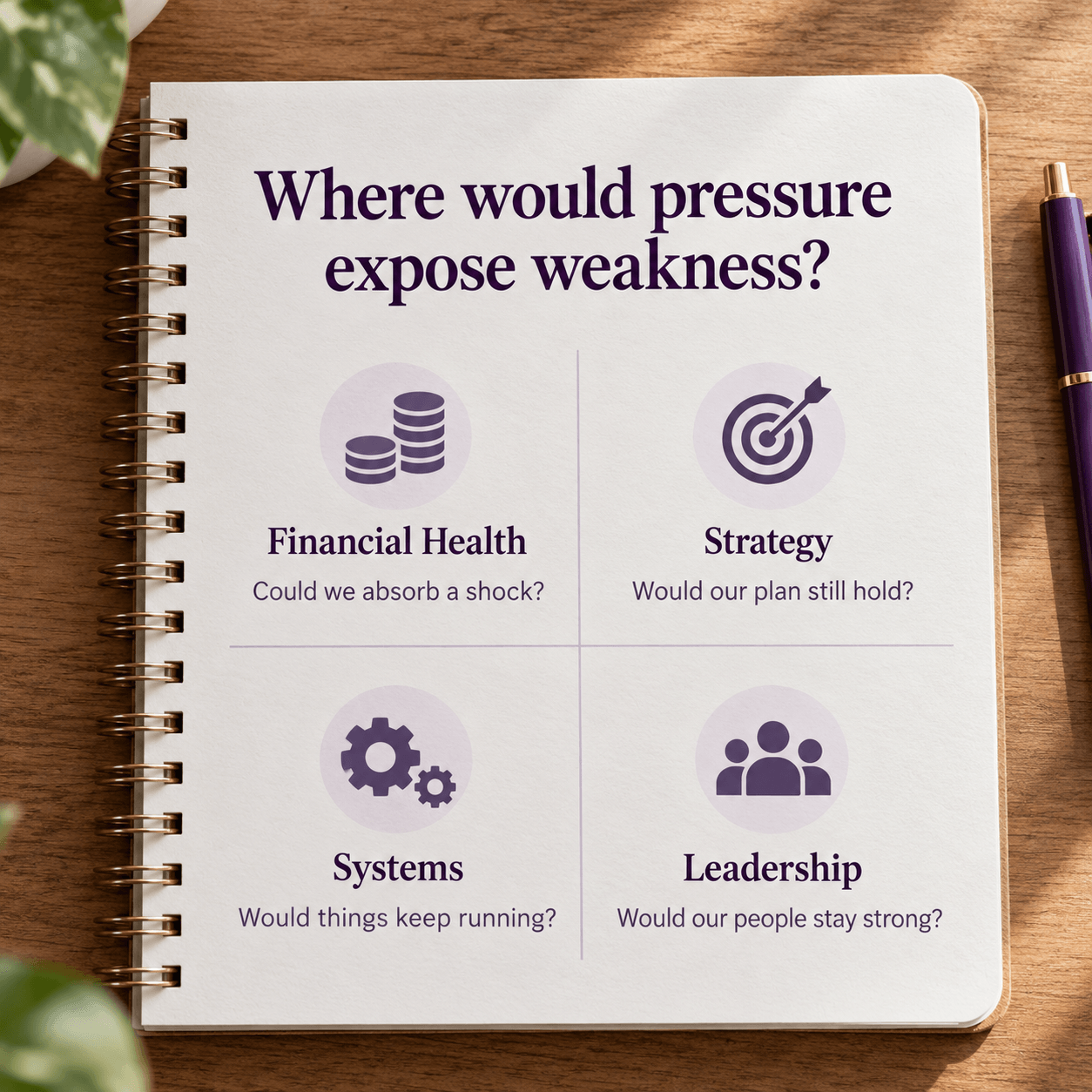
Take the four areas we've used throughout the September Reset and look at each one again.
This time, imagine that things become more difficult.
Financial Health
- What happens if staffing due to bad weather becomes a real challenge?
- Could you absorb a period of higher agency use?
- Do you have enough visibility to spot financial pressure quickly such as increase fuel and food costs?
- Are there placements or contracts that already have very little margin to absorb increased costs?
- And if costs rise, do you have the evidence you need to support a fee discussion?
A financially healthy business has options when something goes wrong.
A financially fragile business has none.
Strategy
When things become busy, does everyone still know what matters most? Or does the business immediately become reactive?
When pressure increases, there will always be something competing for attention. Having clear priorities helps you distinguish between what is genuinely important and what is simply urgent.
This is where the three priorities from the last article and in The September Reset Guide become important.
Systems
This is often where pressure exposes weaknesses fastest.
Ask yourself:
- What happens if a key person is unexpectedly absent?
- Can someone else pick up what they do?
- Are important processes documented?
- Is information easy to find?
- Can you quickly see what has and hasn't been completed?
- Are you relying on memory, spreadsheets or one person's knowledge?
Strong systems help good people perform well under pressure.
Weak systems make pressure worse.
Leadership
What happens when several problems arrive at once?
- Can your managers make decisions confidently or do they always come to you for the answers?
- Do they know what they are responsible for?
- Do they know what authority they have?
- Do they know when to escalate something — and when not to?
- Can they see the information they need?
And perhaps most importantly:
If you weren't available, would the business still know what to do?
That question is worth sitting with.
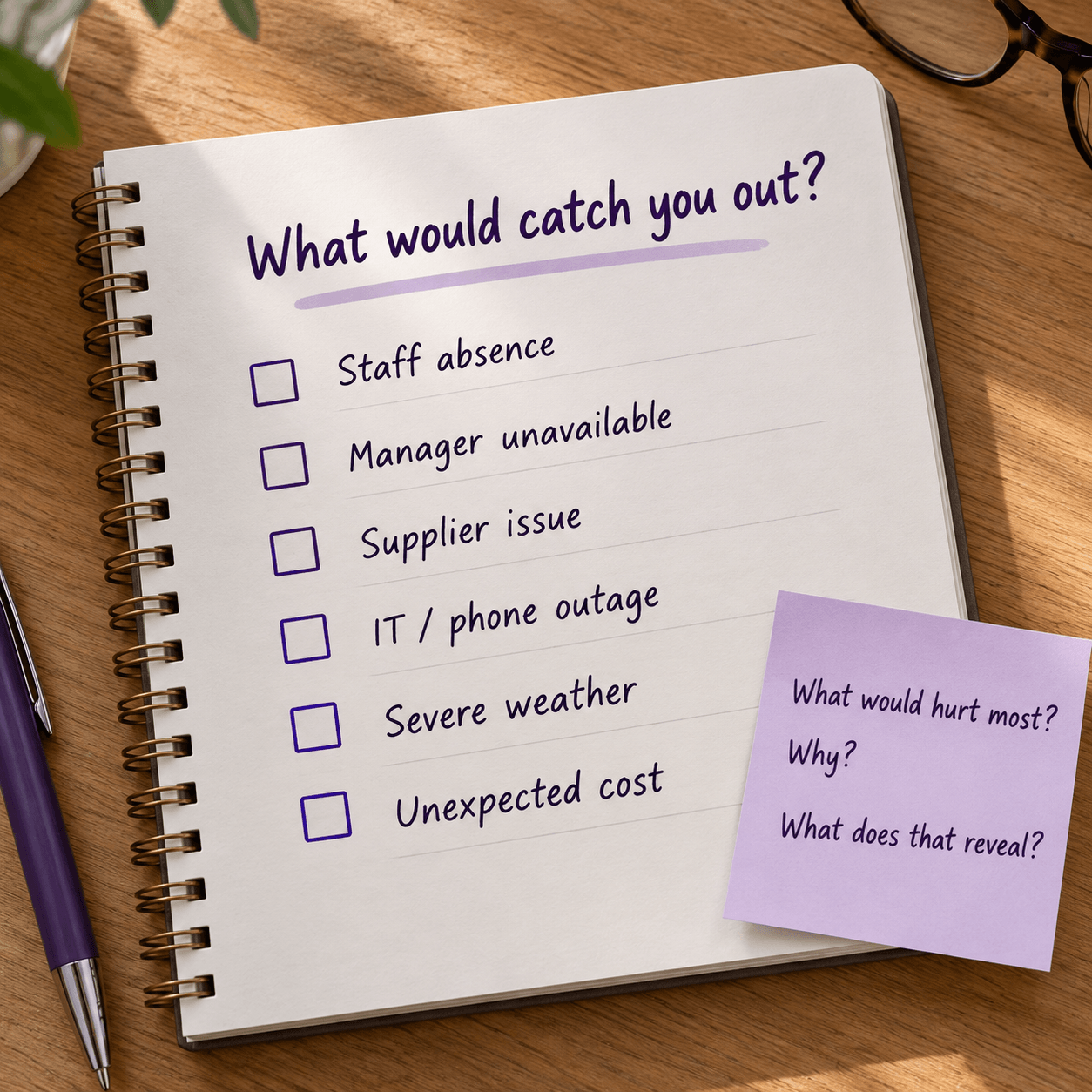
What would catch you out?
Here is a simple exercise.
Imagine tomorrow morning you discover that:
- Three members of staff are off sick
- Your internet or phone system is unavailable
- A key manager cannot come in
- A critical supplier has let you down
- Severe weather is affecting travel
- You have an unexpected financial cost
Not all at once, hopefully.
But ask yourself:Which of those would cause the most disruption?
Then ask: Why?
The answer will often reveal the vulnerability underneath.
- Maybe the problem is not staff absence. Maybe it is that you have no reliable cover system.
- Maybe the problem is not a manager being away. Maybe too much knowledge sits with one person.
- Maybe the problem is not losing internet access. Maybe the business has no practical fallback process.
That is the level you want to get to. Don't just ask what might go wrong. Ask why it would hurt so much if it did.
This is where business continuity matters
A Business Continuity Plan can sound like one of those documents you create because your local authority and CQC says you must have one.
But used properly, it is much more valuable than that.
It forces you to think through the things that could seriously interrupt your service and decide, in advance, what you would do.
- Who takes responsibility?
- Who needs to be contacted?
- What alternatives are available?
- Where is the important information?
- What happens if your normal systems are unavailable?
- How will you communicate?
- How will you maintain care safely?
The worst time to answer those questions is when the problem is actually happening.
So, if you have a Business Continuity Plan, this is a good time to get it out and review it.
And I mean review it, not simply check that a document with that title exists somewhere. Does it reflect the business as it operates today?
- Are the people named in it still there?
- Are the contact details correct?
- Have your systems changed?
- Have your suppliers changed?
- Would your managers actually know where to find it?
- Would it work?
- When was the last time you actually tested it?
If not, you have just identified another area to strengthen.
Don't wait for pressure to create urgency
One of the themes running throughout the September Reset has been this:
Step back while you have the opportunity, rather than waiting until circumstances force you to.
That applies here too.
- If you know your staffing arrangements are vulnerable, strengthen them.
- If one person holds too much knowledge, reduce the dependency.
- If your managers need more clarity, give it to them.
- If your financial visibility isn't good enough, improve it.
- If your Business Continuity Plan is out of date, review it.
None of this is particularly glamorous.
But strong businesses are often built by dealing properly with the things that become very important when something goes wrong.
One final September Reset question
So, as we bring this series to a close, ask yourself:
If my business came under serious pressure tomorrow, where would I be least confident?
That answer is worth paying attention to. It may confirm one of the three priorities you have already identified or it may cause you to change one.
Or it may simply reveal something else that needs to sit on your Not Now list — but not for too long.
Either way, you now understand your business a little better.
And that was the whole point of the September Reset.
To give yourself enough distance from the day-to-day to see what needs strengthening, decide what matters most and take action before the business forces you to.
Complete your September Reset
If you haven't yet worked through the whole series, our free The September Reset Guide brings the exercises together in one place.
It will help you:
- Step back and assess where your business is now
- Identify the areas that concern you most
- Review Financial Health, Strategy, Systems and Leadership
- Decide what needs strengthening
- Choose your three priorities
- And think about how resilient those foundations really are
Download your free September Reset Guide
September may be nearly over.
But strengthening your business certainly isn't.
So, through October, we're going to move from strengthening your business to making it more resilient — looking at how well it would cope without key people, what happens when normal systems fail, and whether your Business Continuity Plan would actually work when you need it.


Products

Home Care Fee Calculator