Winter Ready: A Practical Resilience Checklist for Care Providers
Winter has a habit of testing the parts of a business that are already under pressure. Having a resilient care business is everything so don't wait until you need resilience to discover whether you have it.
Winter brings its own challenges:
- A staffing issue that is manageable today can become much harder when sickness increases or people struggle to get to work.
- A minor building problem can suddenly become much more important when the weather turns colder or wetter.
- A supplier issue becomes more significant when everybody else is trying to source the same thing.
- And a process that works perfectly well when everything is calm can start to creak when managers are already dealing with three other problems.
And this year winter and beyond may bring bigger challenges than most when it comes to testing the resilience of your business.
El Niño is continuing to strengthen and can increase the likelihood of wetter, stormier and generally milder conditions in the UK during late autumn and early winter. That doesn't tell us exactly what weather we'll get, but it does add another reason to think about resilience now rather than later.
'Super El Niño'? '551-mile wall of rain and snow? Weather headline review.
And last week we have felt the start of this with storm Austen, which delayed my ferry crossing from Spain and made it the roughest crossing I have ever experienced, and storm Boelo.
That doesn't mean anyone can tell us exactly what the weather will do in January. But it does give us another reason to think about resilience now rather than wait until the pressure arrives.
And that is really the purpose of this article. This isn't intended to give you every answer but instead be a practical winter resilience checklist — a way of looking across your business, identifying where you may be exposed and deciding where a little work now could make a big difference later.
You won't predict everything that happens this winter. Fortunately, you don't need to.
You just need to make the business a little stronger before the pressure arrives.
1. Staffing — where are you most exposed?
Staffing is probably the obvious place to start.
Winter can make existing weaknesses more visible very quickly. Sickness may increase, travel can become more difficult and the people you already rely on most can suddenly become unavailable.
So rather than simply asking whether you have enough people on the rota today, look at where the fragility sits.
- Which shifts, roles or services are already difficult to cover?
- Where are overtime and agency use highest?
- Who are the people you rely on repeatedly?
- If one manager or senior member of staff was absent for two weeks, what would become difficult?
- Do you have enough people with the right skills to cover important responsibilities?
- Does it tell you what your priorities are?
- Does it cover the systems you actually use today?
- Will it help the person making decisions now?
Then think about what you could strengthen now.
That might mean identifying alternative cover, cross-training staff, developing somebody into a supporting role or simply making sure more than one person knows how a key task is done.
The question is not just “Do we have enough staff?”
It is “Do we have enough resilience around the roles that matter?”
2. Training — do you have enough capability around the business?
Training resilience is about more than certificates being in date.
When staffing becomes stretched, people may work unfamiliar shifts, managers may need others to step into different responsibilities and you may have fewer experienced people available at the same time, which could lead to incidents, accidents or even safeguarding issues.
That makes capability more important, not less.
So take a look ahead rather than only looking at where you are today.
- What training expires over the next three months?
- Who is already overdue?
- Are the same people repeatedly missing booked training to the point that their competence or confidence in key areas may be affected?
- Are there particular skills that only one or two people currently hold?
- If somebody is absent, is another person both available and competent to step in?
Where you identify a gap, or identify overdue training, try to deal with it before winter pressure makes releasing people for training even harder.
The aim is not simply to remain compliant. It is to make sure the business still has enough capable people when circumstances become less convenient.
3. Finance — how much pressure can your margins absorb?
I've said many times – at the core of a strong, healthy business is financial resilience. If your business isn't financially healthy then your entire business is vulnerable.
Winter can quickly highlight any vulnerabilities when costs increase:
- Agency use may rise.
- Overtime can increase.
- Energy and food costs we know will continue to rise.
- Transport and supplier costs can move.
And those increases arrive long before you have any opportunity to recover them through higher fees.
So this is a good time to understand where the pressure points already are.
- Do you know your current break-even point?
- Which clients or contracts are no longer genuinely profitable?
- Are you carrying costs that have not yet been reflected in fees, such as last April's NLW increases?
- What happens to your margin if agency or overtime use increases?
- How much room do you genuinely have to absorb an unexpected cost?
You don't need a perfect forecast, but you do need enough visibility to know where pressure is likely to hurt first.
A financially healthy business has more room to respond when something unexpected happens. So, don't wait, set a time to review your costs and find financially vulnerable areas that will strengthen your business if you address now.
And if your local council owes you money, start to apply regular pressure to get those debts paid.
4. Systems — where does the business still rely on memory?
We all have areas of a business where one person may be the expert - “so-and-so knows”. That is until that person isn't there.
Winter pressure tends to expose informal systems because people have less time to stop, ask questions and work things out.
So think about the important activities that currently depend on somebody remembering what to do.
- How do you deal with a particular type of incident?
- Who contacts the commissioner?
- Where are key supplier details held?
- Who has access to important systems?
- What happens if the person who normally deals with something is unavailable?
- Are there workarounds or tasks that only one person understands?
If something happens regularly or is important to the operation of the service, it is worth turning that knowledge into a clear process.
Good systems are not there to make a business bureaucratic. They are there so people can act confidently without reinventing the answer every time.
5. Leadership — can managers act when pressure increases?
Winter pressure doesn't just test staffing and systems - it tests leadership too.
When several things happen at once, managers need to know what they are responsible for, what decisions they can make and when something genuinely needs escalating.
So ask:
- Are responsibilities clear?
- Do managers know what decisions they can make without asking you?
- Do they know when they should escalate?
- Are they confident enough to act?
- Does everything still travel upwards to the same person?
A resilient organisation does not remove senior leaders from decision-making. It makes sure they are dealing with the decisions that genuinely require senior leadership.
Everything else should be dealt with as close to the issue as possible.
That gives managers confidence and prevents senior people becoming the bottleneck just when the business needs them most.
6. Suppliers and infrastructure — what is your Plan B?
You don't need to imagine a dramatic disaster.
Just look at the things your service depends on every day.
- Heating.
- Power.
- Water.
- Phones.
- Internet.
- IT systems.
- Food.
- Medication.
Then ask a very simple question:
What would we do if this stopped working tomorrow?
- Do you have an alternative supplier?
- Do you have the right contact details?
- Do other people know where those details are?
Could you still access critical information if your normal system was unavailable?
If the answer is “we used to have a backup”, check that it still exists.
Plans, suppliers and telephone numbers all change. A Plan B that worked three years ago may not be a Plan B today.
7. Business continuity — have you actually tried the plan?
Last week I wrote about Business Continuity Plans and why simply having one is not quite enough.
This is a good time to revisit yours but don't make it complicated. If you didn't read last week's article here is the link.
Your Business Continuity Plan: Would It Actually Work?
Pick one realistic scenario and spend twenty minutes talking it through with the people who would actually have to deal with it.
Perhaps:
“Our internet and care-management system are unavailable for six hours.”
Then ask:
- What happens first?
- Who takes control?
- How do staff access the information they need?
- How do you communicate?
- What records do you keep?
- At what point do we escalate?
- What happens if it continues overnight?
If the discussion exposes a gap, that's good because you've discovered it while sitting around a table rather than in the middle of the real situation.
I recommend you make this a quarterly exercise, choosing a different scenario each time.
8. And finally — what still depends on you?
This is the theme I explored earlier this month.
Read: Could Your Care Business Keep Running Without You?
- What still depends entirely on you?
- What information have you never passed on?
- Which decisions can nobody else make?
- Which relationships only exist through you?
- Which processes only work because you understand the workaround?
You don't need to make yourself irrelevant to the business. But every dependency you deliberately reduce gives you more time to lead the business and makes the organisation a little stronger when you aren't there.
Resilience isn't one thing
That is probably the main point I want to leave you with from this month.
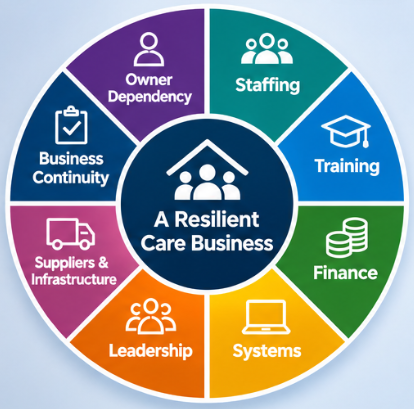
Resilience is not just a Business Continuity Plan. It is not simply having enough staff and it is not being exceptionally good at coping when things go wrong.
It comes from the whole business working together.
- Financial Health.
- Strategy.
- Systems.
- Leadership.
Strengthen those things and you give the organisation more capacity to absorb pressure, respond calmly and keep moving forward.
Don't turn this into another enormous list
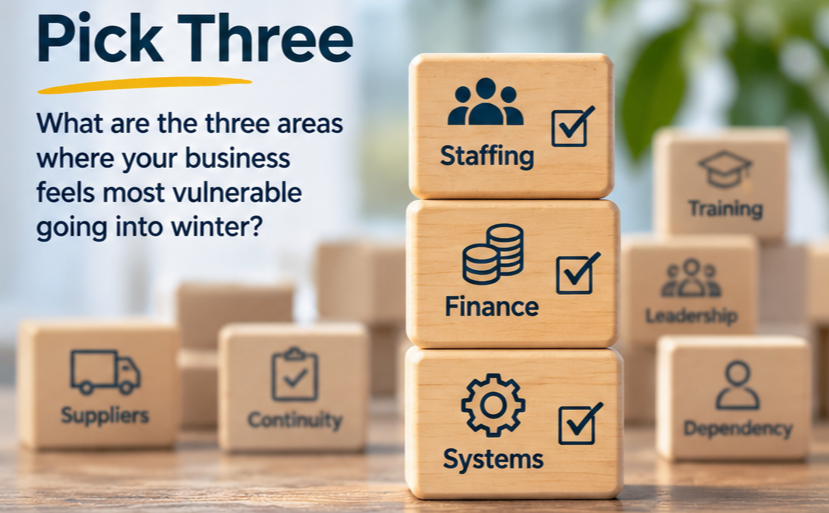
There are a lot of questions in this checklist so instead of feeling you now have another thirty things to do, simply pick three.
What are the three areas where your business feels most vulnerable going into winter?
Write them down and then decide on one practical action that would make each one stronger. Of course, do more if you feel you need to and can. Small steps.
You are not trying to create the perfect organisation before winter arrives. You are simply trying to enter winter stronger than you are today because strong businesses aren't built in the middle of a crisis, they are built gradually, beforehand.
Don't wait until you need resilience to discover whether you have it.
If you need further help with this then check out our September Reset Guide. Like a puppy isn't just for Christmas, this guide isn't just for September so don't let the title put you off, it can really help.


Products

Home Care Fee Calculator