Have April's Wage Increases Hit Your Care Business Harder Than Expected?

April's cost increases in National Living Wage and National Minimum Wage have now started to show up in your payroll, invoices, management accounts and cash flow.
What may have looked difficult but manageable at the start of the financial year can feel very different once the real costs start moving through your business.
For many care providers, staff costs alone are likely to have risen by at least 7%. Add rising food, fuel, utilities, insurance, repairs, training and other running costs, and the overall pressure on your business is likely to be even higher.
And these costs are not standing still - they are likely to continue rising through the year - which is so important that you pause and review your position.
The key question is not simply: “Have our costs gone up?” (Yes, they have.)
The real question is: “Do our current fees return the profit our business needs to be financially healthy?”
April's cost increases are now real
Before April, you knew costs were going to rise.
You may have already looked at wage increases, employer on-costs, pension contributions, holiday pay, sickness cover, agency use and supplier costs. You may also have thought about the impact of fuel, food, utilities, insurance, maintenance and general overheads.
But there is a big difference between knowing costs are going to rise and seeing the actual effect on your business.
Now, the numbers are much more real.
This is the point where you need to look carefully at what is actually happening. You need to know what profit margins you are returning on each of your clients in case some are so low – or even now loss-making – that they are financially harming your business.
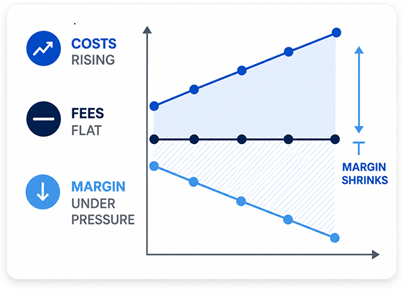
If your costs have changed but your fees have not, your profit margin has
If your costs have increased and your fees have stayed the same, your profit margin has reduced.
This is why, if you didn't review and negotiate higher fees before the cost rises, you definitely should now.
A full care home can still be financially unsustainable.
A busy home care service can still be undercharging.
High occupancy or high care hours do not automatically mean strong profitability. If the fee is too low, being busy can simply mean delivering more care at an unsustainable rate.
Staff costs are not just about the hourly rate
When staff costs rise, the impact is wider than basic pay.
You also need to think about:
- Employer National Insurance
- Pension contributions
- Holiday pay
- Sickness cover
- Overtime
- Agency costs
- Supervision
- Recruitment
- Induction
- Training
- Management time
-
Retention pressures
A wage increase does not sit neatly in one line of your accounts. It affects the whole cost of running the service.
On top of that, your spend with suppliers will increase as they increase their prices to cover their own cost increases.
For care homes, this can change the true cost of each placement. A resident who was previously just about viable will no longer be viable at the same fee. A dependency level that was already underfunded may now be creating a much bigger financial gap.
For home care providers, the position can be even more exposed. The hourly rate may not properly reflect the true cost of delivering that hour of care once travel time, mileage, gaps between calls, cancelled visits, supervision, rostering, quality monitoring and office costs are included.
This is why you need to calculate the real cost of care, not just look at the rate being paid.
Fuel costs affect more than mileage
Fuel costs are an obvious concern for home care providers.
If your care workers are travelling between visits, rising fuel costs can quickly reduce the viability of packages, especially where runs are spread out, visit times are short, or mileage is not fully covered.
If you don't pay fuel costs, then fuel the fuel hike may just a step to far for some of your carers and you risk losing them. Either way, this is a problem you shouldn't ignore.
But fuel costs also affect care homes. Some staff may be travelling significant distances to get to work. If the cost of that journey becomes too high, they may start looking for jobs closer to home.
That creates another risk for providers.
You may find yourself under pressure to increase pay, offer incentives, adjust rotas, contribute towards travel costs or use more agency staff simply to retain good people.
In other words, fuel costs are not only a transport issue. They can also be a workforce retention issue. And in a sector where good staff are hard to find and expensive to replace, that matters.
Food and running costs are still rising too
Staffing is by far the largest cost pressure, but it is not the only one.
Food costs continue to affect care homes directly. Even relatively small increases can have a significant impact when multiplied across every resident, every meal, every day.
For all care providers, regardless of the type of service they run, costs have mounted throughout your business. You need to look at your full cost base and understand what has changed, what is still changing and whether your fees are keeping pace.
Cost control is vital
Even though costs out of your control have risen and will continue to rise that doesn't mean you shouldn't look at how to make your business run as cost effectively as possible.
This will also help you when negotiating for higher fees. Showing that you have systems and processes in place to record, monitor and act on over-spend will increase your credibility and strengthen your negotiating position.
A commissioner has every right to question your costs and know that a portion the increase in the fee you need isn't attributable to your inability to control your costs.
Before you can control costs, you need to know where the money is going.
You need to understand:
- which costs have increased
- which costs are fixed
- which costs are variable
- which costs are linked to staffing
- which costs are linked to occupancy or care hours
- which costs are reducing your margin
-
which costs are likely to rise again later in the year
If you only review your costs once a year, you may spot the problem too late. By the time the issue becomes obvious, you may already have absorbed months of reduced margin.
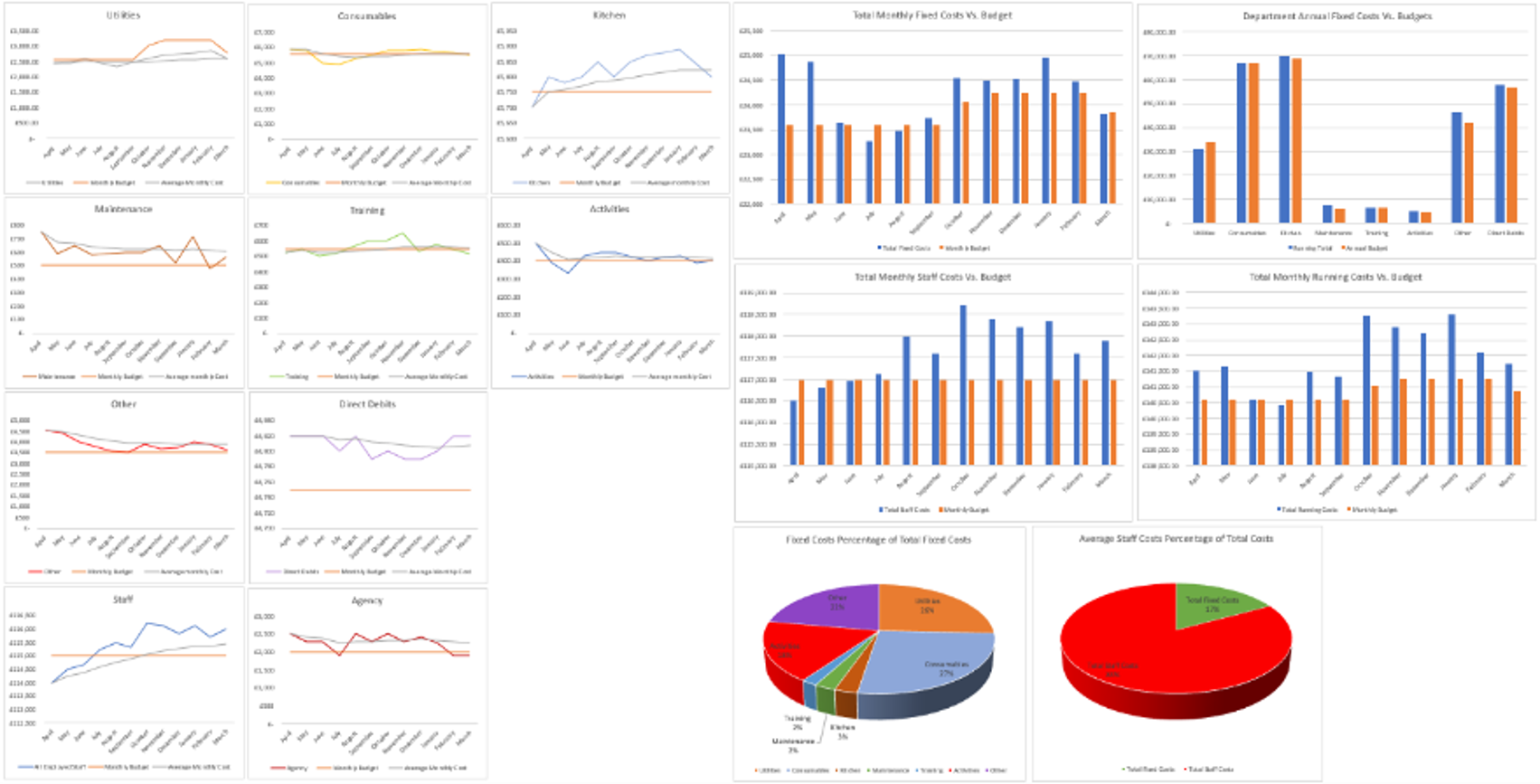
Ideally, your costs need to be recorded daily or at least time set aside say at the end of the week record all that week's spend.
The Running Cost Calculator has been designed to help you record, monitor and understand your costs and spend. It gives you a practical way to keep track of what is happening in your business, rather than relying on assumptions or outdated figures.
It comes with a 30-day free trial so you can see if it works for you.
The power of creating accurate fees
Once you know your current costs, you can create accurate, detailed fee quotes based on those costs for all your clients.
Provided it is detailed enough, that new fee calculation will help you in four key ways.
- It will highlight which fees are returning a profit margin that is below your red line level and which you therefore need a client review to increase.
- It will give you the clarity and confidence to negotiate and depending on the success of that negotiation whether to keep the client or serve notice.
- You will no longer be asking for a fee increase but instead explaining why you need the increase, supported by detailed evidence.
- You will strengthen your negotiating position because you will be able to justify all your costs and eliminate all the ways commissioners try to convince you your quote is wrong.
In conversations I've had with directors of commissioning they all say the same. Show us the evidence. An accurate, detailed breakdown of the cost of delivering care for a particular client is essential if you want to get paid the fee you need.
For care home providers, the Care Fee Calculator helps you calculate, evidence and justify the fees you need for different placements.
Of course, there is no guarantee that your commissioner will agree to pay but because it is fully justified with no guesswork, they will know that this is the fee they need to pay and the pressure will be on them to pay. (The Care Act adds that pressure.)
And it does work. One provider struggled to get a fee increase from £460 a week. The council refused to increase the fee even though it was obvious he was subsidising the person's care.
Using the Care Fee Calculator he showed the fee he actually needed - £2,076 a week - and with the detailed evidence the tool gave him, the council stopped stonewalling and began paying.

For home care providers, the Home Care Fee Calculator helps you calculate and evidence the true cost of delivering care, including the hidden costs that can easily be missed.
Again, there is no guarantee that you'll receive the fee you need but by providing the evidence you make it harder for your commissioners to simply say they will offer to another provider. (Care Act.) And you at least will know what fee level you can and absolutely cannot accept.
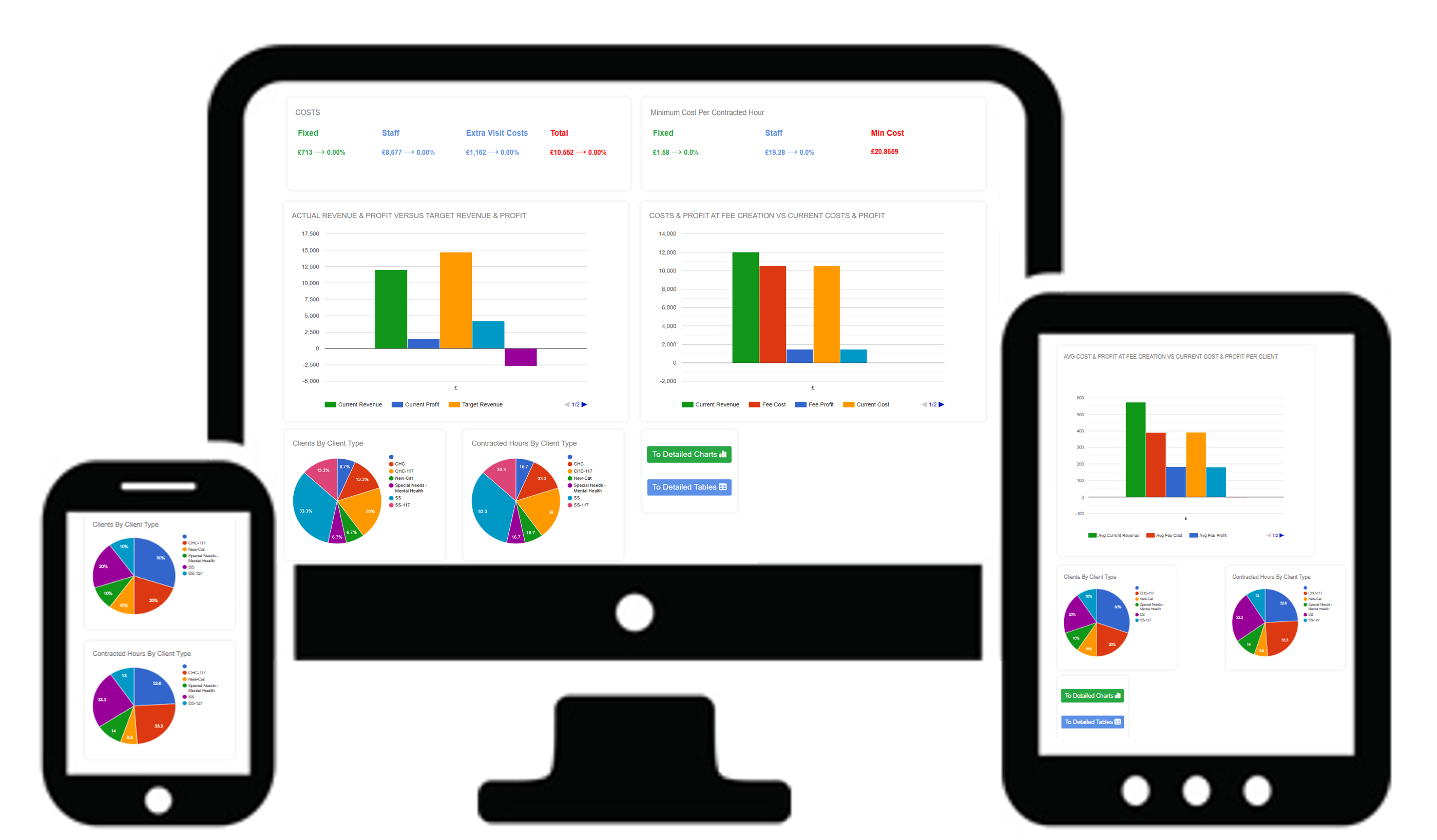
Used alongside the Running Cost Calculator, these tools help you move away from guesswork and towards evidence.
That evidence matters.
It also helps you understand your own business more clearly. It helps you make better decisions about placements, packages, fee levels and cost control. It also gives you a stronger basis for conversations with commissioners, funders and decision-makers.
A fee uplift will not touch the real increase in costs
If you have received an uplift from your local authority, you know it won't cover the increase in your costs. Not even close. It never has and never will and so you should never rely on it.
That uplift is for the commissioner to use in their own negotiation and budget process. Your job is different. Your job is to understand and evidence what it actually costs you to deliver safe, sustainable care and return a healthy profit.
But if your commissioner insists on including the uplift in a negotiation, it's simple. “2% uplift - well I'm willing to take 2% off the fee increase I need.”
Now is the right time to act
June is an ideal time to review your position.
It is far enough into the financial year for April's increases to be visible, but early enough to take action before the pressure builds further.
This is the time to ask:
- Have our staff costs increased by at least 7%?
- Have food, fuel and running costs increased too?
- Are these costs likely to keep rising through the year?
- Are our current fees based on our real costs?
- Are we relying too heavily on a commissioner uplift?
- Are some placements or packages now financially unsustainable?
- Are we monitoring our running costs closely enough?
- Do we have the evidence we need for fee discussions?
- Are we making decisions based on current figures or last year's assumptions?
These are not just finance questions.
They are business sustainability questions.
If your fees do not cover your costs, the pressure eventually affects every part of the service: staffing, quality, training, investment, resilience and long-term viability.
Do not let the commissioners uplift define your fee
This is worth repeating.
The fee uplift offered by a commissioner should not be the starting point for calculating your fee.
Your starting point should be the actual cost of delivering the care.
That means understanding your staffing costs, running costs, overheads, dependency levels, travel costs, food costs, management costs and required margin.
Once you know the true cost, you are in a much stronger position.
You can explain the fee you need.
You can show how it has been calculated.
You can demonstrate why the current rate is not sustainable.
You can move the conversation away from general pressure and towards clear evidence.
But you cannot negotiate effectively if you do not know the fee your business actually needs.
Do not wait until the problem becomes unavoidable
As care providers you are used to managing pressure.
You adapt. You absorb. You keep services running.
But that can create a real risk.
Financial pressure can build gradually in the background until it becomes much harder to fix. A small shortfall each week or each month can become a serious problem over time.
Which is why care providers across the country are closing their business each week. Not because they want to but because they simply can no longer financially sustain it.
The earlier you identify the gap between your costs and your fees, the better placed you are to respond.
That might mean reviewing fees, gathering evidence for commissioner discussions, reassessing packages, reviewing placements, improving cost monitoring or identifying where spend needs closer control.
The key is to act with evidence rather than assumption.
The key message
If April's wage increases have hit your care business harder than expected, you are not alone.
But you do need to understand the impact properly.
Staff costs may have increased by an estimated minimum of 7%. Food, fuel and other running costs are also rising. These pressures are likely to continue through the year.
A commissioner uplift will not come close to covering the real increase in costs.
So now is the time to check.
Do your current fees still cover the true cost of delivering care?
Are you monitoring your running costs closely enough?
Can you evidence the fee you need?
If the answer to any of those questions is uncertain, now is the right time to act.
How Quality of Care can help
Quality of Care provides practical tools to help you understand costs, calculate fees and evidence the financial reality of delivering care.
The Running Cost Calculator helps you record and monitor your costs and spend, giving you clearer visibility of where money is going and where pressure is building.
The Care Fee Calculator helps care homes calculate, evidence and justify the fees they need.
The Home Care Fee Calculator helps home care providers understand the true cost of delivering care and evidence the fees required to provide that care sustainably.
April's cost increases are now showing up in your figures. This is the time to review your costs, check your fees and strengthen your evidence.


Products

Home Care Fee Calculator



